

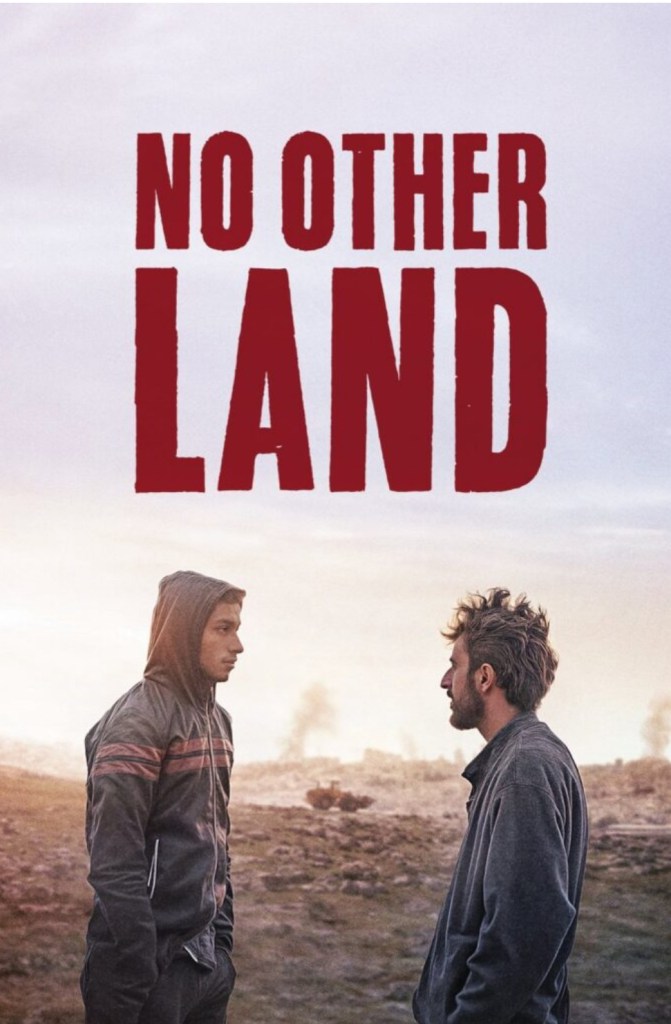
No Other Land
A Film by Basel Adra, Yuval Abraham, Rachel Szor, and Hamdan Ballal
1 hour, 32 minutes
Logline: A film made by a Palestinian-Israeli collective shows the destruction of the occupied West Bank’s Masafer Yatta by Israeli soldiers and the alliance that develops between the Palestinian activist Basel Adra and Israeli journalist Yuval Abraham. (IMDb)

by Kat Valdez (she/her)
As the closing credits rolled for No Other Land, the audience was silent.
The silence continued as we, an audience of about 30 people at this March 9 screening, walked out of the theater at The Lyric, one of the few independent movie theaters across the U.S. showing the film.
In the lobby, packed with a lively crowd answering trivia questions, we finally exchanged looks, as though we had shared a traumatic experience. Because we did.
Wow.
Even after winning the 2025 Academy Award for Best Documentary Feature on March 2, the film still does not have a U.S. distributor. (Still true upon publication of this review.) The filmmakers are booking individual screenings through Cinetic Media and a distribution consultant.
Why? Too controversial. People who speak against the U.S. government’s actions (“Stop Funding Genocide!”) are accused of being antisemitic, and movie theater owners probably don’t want to risk demonstrations in front of their box offices. Or worse, eviction. (See the NPR story “Movie theater in Miami Beach faces eviction after showing documentary No Other Land.”)
“This is a story about power. I grew up hearing it,” Basel Adra says in the film.
He’s referring to a story from years ago: then-British Prime Minister Tony Blair walked along streets in the Gaza Strip community of Masafer Yatta, a collection of about 20 villages; the U.K. leader’s mere presence was enough for the Israeli government to later rescind orders to destroy homes along those streets.
But Adra could have been speaking about the entire Israeli-Palestinian conflict.
The documentary introduces Adra and his family with video clips of him smiling as a 10-year-old boy and his father, who despite having no formal education, is a perpetually upbeat, energetic, and charismatic community leader who runs what appears to be his village’s only gas station.
Adra, a second-generation activist, has two tools his father didn’t: a smart phone and fluency in English. He now spends much of his time documenting Masafer Yatta being destroyed one home at a time and turned into a military training zone by Israeli soldiers who justify their actions by coldly and simply stating, “It’s the law.”
We see Adra and Israeli journalist Yuval Abraham becoming unlikely allies and friends as they work together to show scene after scene of bulldozers descending on people’s houses, in some cases not even allowing residents to remove their possessions before the house crumbles under the bulldozers’ claws.
Crying, screaming in outrage, despair…every human emotion is on display. How can this be happening you think, cringing and feeling sick. You feel a moment of gratitude for living a relatively safe life in the U.S.
But that’s changing, too, for some people. If you’re a woman, or a person or color, or a member of the LGTBQIA+ community, you’re not truly safe.
At one point a neighbor is shot, off camera, for trying to rebuild his family’s destroyed home. His mother ends up drenched in his blood. We later learn he’s paralyzed from the shoulders down and his family is forced to live in a cave. Community members march and carry signs “Justice for Harun.” Harun Abu Aram’s final weeks (months?) are spent lying in a sheet on a cave floor, depressed and refusing to see anyone but his mother, Farisa Abu Aram, and sister, a blonde little girl who looks like she could be your next door neighbor’s kid here in the U.S.
Near the end of the film, after Adra explains how the community members built their school with grant funds, that school, too, crumbles under a bulldozer.
We see a cement truck filling a well with cement, the family’s only water source, and the despairing cry of an older man yelling in Arabic, “Water is a human right!”
Another man is shot, this time on camera, as neighbors continue protesting the injustices.
One night, Adra is barely standing and unresponsive. Abraham, who is about to drive to the safety and sanctuary of home (unlike the Palestinians, he can drive freely between the West Bank and Israel) asks Adra, “Are you angry with me? Are we good? ” Adra replies, “Just tired.” We can see it on his face: he’s numb from weariness, from years of fighting against his community’s destruction.
It’s easy to see why this documentary rose to the top of the list of 45 documentaries and won the Academy Award.
After texting a friend about this film and encouraging them to see it, they replied, “That looks so depressing I dunno if I can take it right now!” Understandable. We each have our own emotional wounds and trauma to heal, some more than others; some deeper than others.
But the film shows perseverance and hope. Despite mortal danger, the villagers continued to march and protest for as long as they could.
Those of us who can see it, should. Then add your voice to the millions calling for justice.
Kat Valdez mostly loves rom-coms and superhero movies but recently decided to stop wallowing in existential dread by taking time to watch documentaries about critical issues facing people all over the world, such as those featured in the ACT Human Rights Film Festival.
Read more:
Support Masafer Yatta
Rabbis For Human Rights
“The Group Behind Project 2025 Has a Plan to Crush the Pro-Palestinian Movement“ (The New York Times, May 18, 2025)
“No Other Land and the Brutal Truth of Israel’s Occupation” (The Nation, Nov. 4, 2024)
“Documentary ‘No Other Land’ looks at Palestinians forced from homes in the West Bank” (NPR, Nov. 21, 2024)
“No Other Land Filmmaker Hamdan Ballal Released, Says Co-Director” (The Hollywood Reporter, March 25, 2025)
The Defiant Curtsy: Pop culture through an equity and inclusion lens

 The Defiant Curtsy